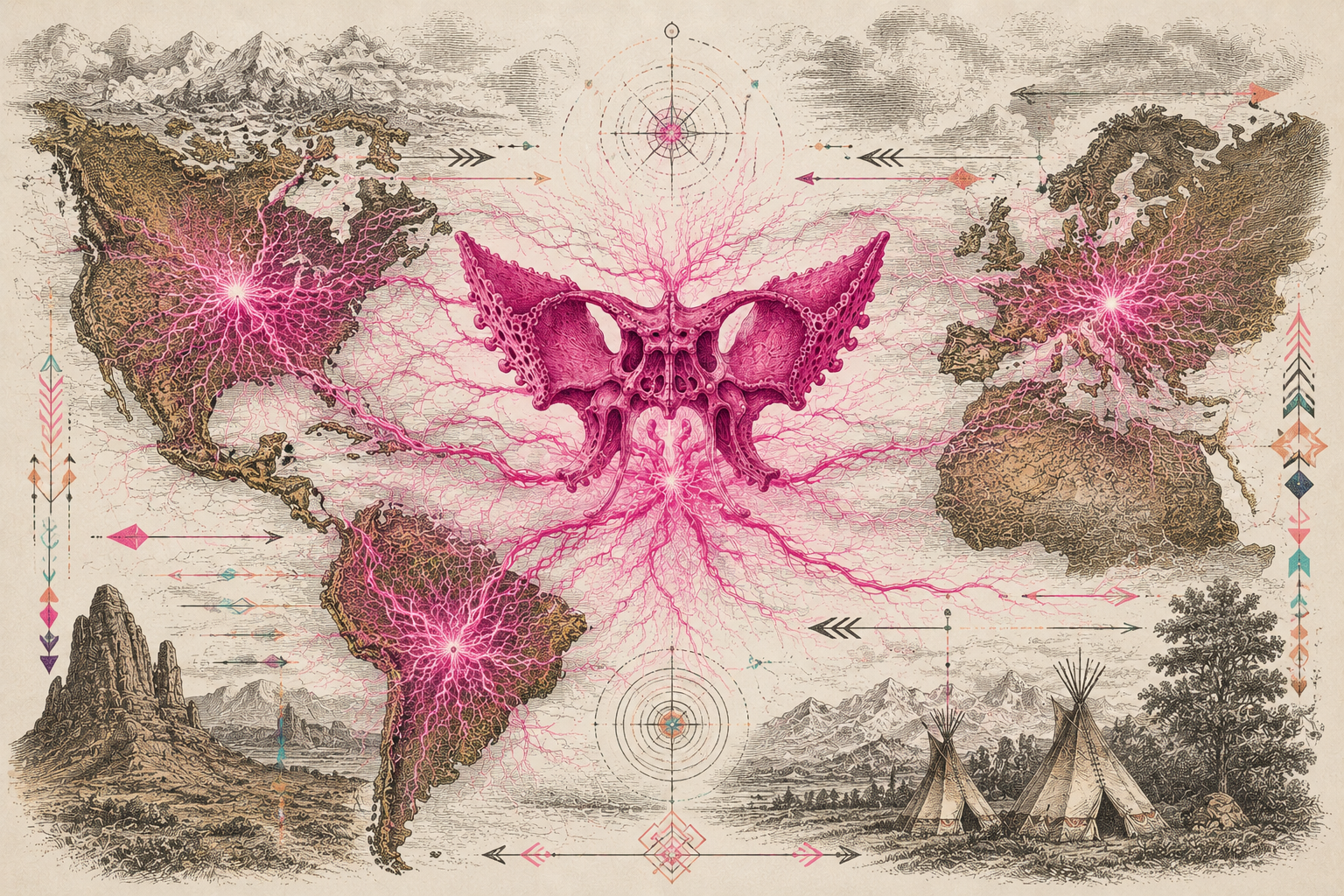
Not a discovery.
Perhaps a rediscovery.
Jeff Romanowski has said that he does not believe he invented this method — only that he found it again. That what the body knows how to do when given the right conditions is something human beings have always known. He spent thirty years learning how to create those conditions reliably.
Early 1990s
The tremor that started everything.
The interest that eventually became the Romanowski Method began in the early 1990s, when Jeff Romanowski — then a licensed practitioner trained in the Paul St. John Method of Neuromuscular Therapy — began noticing something unexpected in his sessions.
Clients were trembling. Not from cold or fear, but from something else — an involuntary shaking that arose at specific moments in the work. Rather than treating this as a side effect to be managed, Jeff became curious. He wanted to understand what the body was doing — and whether it could be reliably recreated.
"The tremor experienced during the work is the way the nervous system finds to release trauma and return to a parasympathetic state. Many people carry traumas in varying degrees and remain in a state of vigilance — as if waiting for the next event."
— Jeff Romanowski
Years of trying, failing, and refining.
The threshold
The early work involved a crucial observation: the clients who experienced tremors had reached a threshold of discomfort — but had not crossed into actual pain. That took years to be fully understood. Many attempts failed. The concept of the threshold — that precise edge between resistance and release — required time and practice before it could be structured into something teachable and repeatable.
A turning point
In the 1990s, Jeff worked with two clients who had been diagnosed with multiple sclerosis. Both showed real MS symptoms — and both also carried histories of severe trauma. What happened in their sessions was extraordinary. The desire to understand those results became one of the central motivating forces behind the continued development of the method for years afterward.
What those sessions suggested is that what can look like a miracle may in fact be what happens when a person in a state of chronic stress finds genuine surrender. The nervous system, released from its vigilance, reorganises itself.
"Until today, it is difficult to explain exactly what occurs. Perhaps it will be possible after a scientific study."
— Jeff Romanowski
1995 — Croatia
When the method met its deepest test.
In 1995, musician Paul Winter invited Jeff to Croatia to work alongside a benefit concert for people displaced by war. What happened in those sessions — with people carrying the heaviest possible weight, often seen only once — was undeniable. The method worked under conditions that tested its limits and proved its depth.
The results moved people enough that they wanted to learn. Jeff returned to Croatia for seven consecutive years — to teach, to give sessions, to build something in a place that needed it.
Beyond the physical
When it became clear this was more than pain relief.
People began having transformations during the sessions themselves. Some described a state of presence so complete that past and future simply ceased to be relevant. Others spoke of removing masks — as if filters they had worn for years had been lifted, and they were experiencing the same world through entirely different eyes.
"The capacity of this work to remove the label created by the self leads to internal sensations of change that open new possibilities for people to be in the world. Once these changes occur, the external environment is seen through fewer filters."
— Jeff Romanowski
Ancestral roots
Knowledge that may be older than the method.
Jeff Romanowski does not claim to have invented what the method accesses. He believes this knowledge has existed for a long time — carried by indigenous peoples, by hunter-gatherers, by those who understood the body's capacity for self-restoration long before modern therapeutics could name it.
His years of exchange with indigenous traditions — including time spent with the Yawalapiti people in the Alto Xingu region of Brazil, and years of dialogue with North American indigenous traditions — deepened his understanding of the body as a complete system, one whose intelligence does not need to be taught, only allowed. These exchanges did not change the structure of the method. They confirmed something about its nature.
The dance
What it takes to become a practitioner.
Jeff often speaks of the work between practitioner and client as a dance. Technique can be taught. Presence, attunement, the capacity to hold another person's process without interference — these are developed over time, through experience, through one's own sessions on the table.
Becoming a good dancer, he says, is the key to any practitioner's success.
" Even today, the Romanowski method remains a mysterious ritual to me—a form of therapy where strength and gentleness coexist. It is a place where I offer myself to the dance, and that dance leads me into a state of flow: deeply alive, vibrant, and creative."
— Mariana Candeia